Your Safety Alerts Are Working. They're Still Failing.
We measured what happens after the classifier fires. Across 377 high-severity alerts, 100% were emailed successfully — and 212 were never touched. 95% arrived outside school hours, and not one of 29 organizations had named a human to receive them. Detection is solved; the last mile isn't.
Two weeks before students come back, the student safety monitoring conversation will be about detection. Which platforms get scanned. Which categories get flagged. How good the AI is.
Detection is the part that already works.
We pulled every high-severity alert our platform has generated since February — 377 of them, across 29 organizations — and measured what happened after the model made its decision. The detection layer performed. The alert fired, the row was written, the email went out in about two seconds.
Then 212 of those alerts sat untouched. Every single one had been successfully emailed. Not one had been opened, dismissed, or acted on.
That is the last mile problem, and it is where student safety monitoring actually fails. Not at the model. At the handoff.
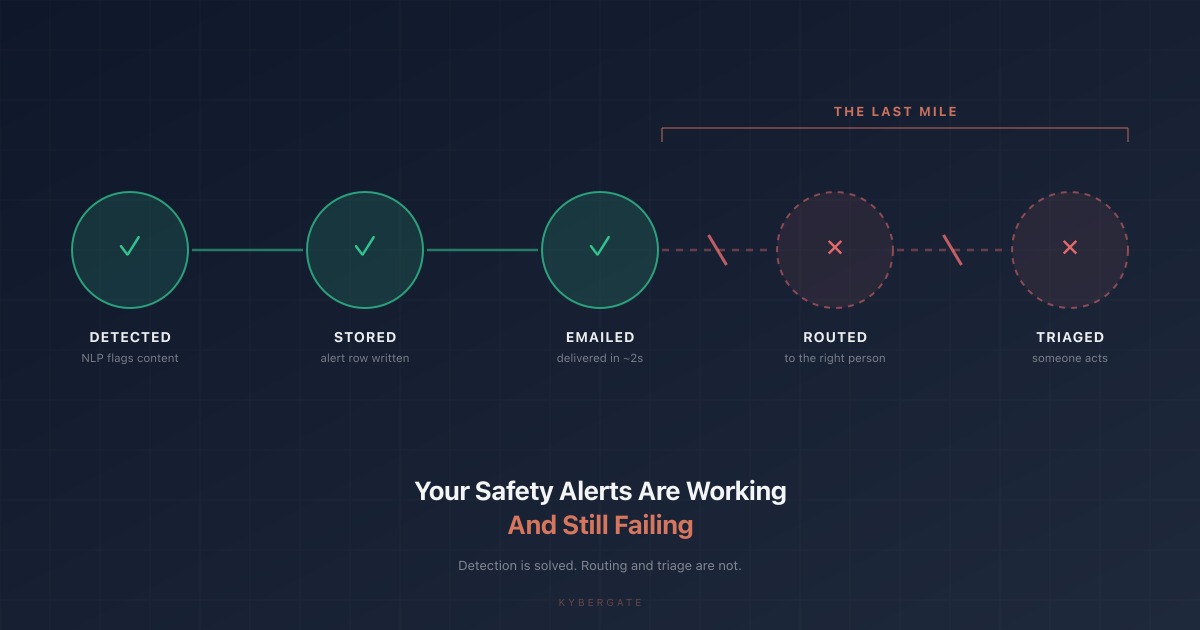
The pipeline is five steps, and vendors only sell you three
Every safety monitoring system runs the same chain:
- Detected — the classifier flags content
- Stored — an alert row is written
- Emailed — a notification is delivered
- Routed — it reaches the right human
- Triaged — that human acts
Steps 1 through 3 are engineering problems, and they are solved. They are also the only three steps that appear in a product demo, because they are the only three a vendor fully controls.
Steps 4 and 5 are the ones that determine whether a child gets help. They are organizational problems wearing a technical disguise, and almost nobody audits them before signing.
Here is the uncomfortable framing: a delivered email is counted as a success by every monitoring platform on the market, including ours. Delivery is where vendor accountability ends and where the actual safety question begins.
Finding #1: The alert almost never arrives during school hours
This is the number that reframed the problem for us.
We converted every high-severity alert timestamp to Eastern time and asked a simple question: what fraction land outside a normal 8:00 AM – 4:00 PM weekday window?
95.2%.
Our first instinct was that this was an artifact — that our own scanners run on overnight cron schedules, so the timestamps reflect when we scanned, not when the student acted. That is a real effect, and it would have invalidated the finding. So we filtered to only real-time sources — live search, browsing, and chat events, which are timestamped at the moment of student activity, not at scan time.
The number barely moved: 95.2%, on 124 real-time events.
Then we tested the second obvious confound. This data spans a summer, when school is not in session and everything is technically "after hours." So we cut the dataset to alerts generated before mid-June — during the actual school year.
93.1%.
The finding survives both controls. The distribution has a clear peak in the 7:00 PM–9:00 PM range, and 40.6% of high-severity alerts arrive between 10:00 PM and 6:00 AM. Eighteen percent land on a Saturday or Sunday.
This is not surprising once you think about it for ten seconds. A student in crisis is not in crisis during third period. They are alone, at night, on a school-issued device.
The implication is brutal for email-only alerting. If 93% of your alerts arrive when nobody is at a desk, an email-only pipeline is not a safety system. It is a system that generates a very well-documented record of things nobody read until Monday.
What to ask a vendor: "Show me the hour-of-day distribution of high-severity alerts in a comparable district. Then show me your after-hours escalation path."
Finding #2: Nobody is named, so the default catches everything
We checked how many notification contacts were configured across all 29 organizations on our platform.
Zero.
Not "a few were missing." Zero organizations had designated a specific human being to receive safety alerts. Zero had an SMS-capable contact.
When no contact is configured, our system does what every system does: it falls back to the organization's admin email address. That address belongs to the person who set up the account — which, in K-12, is almost always the IT director.
So the chain terminates like this: a classifier detects a possible self-harm signal from a 14-year-old at 11:40 PM on a Saturday, and it emails the network administrator, who is not a clinician, has no authority to conduct a wellness check, and is not on call.
Nothing is broken. Every component reports success. The email was delivered in two seconds.
This is the single highest-leverage fix in student safety monitoring, and it takes about fifteen minutes. It is not an AI problem. It is a field in a settings page that no one filled in, because nothing in the purchase process ever forced the question.
We consider it a product defect that our platform ever allowed safety monitoring to be enabled with zero contacts configured. A system that can page nobody should refuse to arm itself.
Finding #3: The queue decays, and the decay is measurable
Once an alert lands in a queue nobody owns, it does not get triaged later. It gets buried.
The numbers across our full high-severity set:
| Metric | Value |
|---|---|
| High-severity alerts generated | 377 |
| Successfully emailed | 100% |
| Still in `new` status | 212 |
| Never reviewed by any human | 52.3% |
| Median time to review (when reviewed) | 382 hours (~16 days) |
| Age of oldest unreviewed critical alert | 173 days |
A median time-to-review of sixteen days is the part worth sitting with. For a category like self-harm, a sixteen-day response is not a slow response. It is a non-response with a timestamp attached.
And 173 days means an alert classified as critical has been sitting in a queue since roughly the start of the spring semester.
Nobody in these organizations is negligent. That is the important part. The IT directors receiving these emails are doing their jobs. They are simply the wrong recipient for a clinical signal, and no part of the system ever told them so — or told anyone else.
Finding #4: Precision and routing are the same problem
Across every alert that a human actually adjudicated, 39.2% were marked false positive.
We wrote about why that number breaks monitoring programs — a queue full of newsletter false positives trains reviewers to stop believing the queue.
But routing and precision are not two problems. They are one, and they compound in the worst possible direction:
- Bad precision makes people ignore the queue.
- Bad routing means the person ignoring the queue is the wrong person anyway.
Fix precision alone and you get a clean queue that the IT director still cannot act on. Fix routing alone and you page a counselor at 11 PM with a sports newsletter, once, and then never again — because they will mute you.
You have to fix both, in that order: tighten precision first, then route to a human who can act. Routing high-noise alerts to a clinician is actively worse than not routing them, because it burns the one channel you will need in an emergency.
The last-mile audit: 6 questions before September
You can run this against any vendor, including us. None of it requires a technical evaluation.
1. Who, by name, receives a critical alert at 11 PM on a Saturday? If the answer is a role, a distribution list, or "the admin account," you do not have an answer.
2. What happens if that person does not open the email? No escalation path means email delivery is your safety plan.
3. Is there a non-email channel for critical severity? Email is an asynchronous medium being used for time-sensitive events. SMS or push is not a luxury at 40% overnight volume.
4. What is your median time-to-review, and can the system show it to you? If the platform cannot report this, it cannot tell you whether it is working. Ours could only answer because we went and queried it directly — which is itself a gap we are fixing.
5. Can a reviewer dismiss a false positive without reading a minor's private content? The alert should carry the matched term, the sender, and the classifier's confidence. Requiring a human to read a student's email to adjudicate a false positive is a CIPA/COPPA/FERPA problem, not just a UX one.
6. What is your alert backlog right now? Ask for the count of alerts in an unreviewed state older than 30 days. The number will be uncomfortable. That discomfort is the point.
What we are changing
We are not writing this as a competitive attack, because the data above is our own platform's. The detection worked. The delivery worked. The outcomes still did not happen.
Three changes, in priority order:
- Refuse to arm safety monitoring with zero notification contacts. Provisioning should block, not silently fall back to the admin account.
- Add a real escalation path for critical severity — SMS for the categories where minutes matter, with acknowledgment tracking, so an unacknowledged critical alert escalates instead of aging.
- Surface queue health as a first-class metric. Median time-to-review and unreviewed backlog belong on the dashboard, not in a database query. A safety program that cannot see its own backlog cannot manage it.
Bottom line
The industry spent five years making detection good. Detection is good. Our classifiers correctly flagged self-harm, violence, and weapons content hundreds of times.
Then 212 of those alerts went to an inbox where nobody was looking, at an hour when nobody was awake, and 52.3% were never read by anyone.
Better AI would not have changed a single one of those outcomes.
Before you evaluate another detection engine this fall, go find out who on your staff receives the 11 PM alert — and whether they know they receive it. That fifteen-minute conversation will do more for student safety than any model upgrade you buy this year.
Related Reading
Ready to protect your students?
Deploy KyberGate in under 30 minutes. No hardware required.
Request a Demo